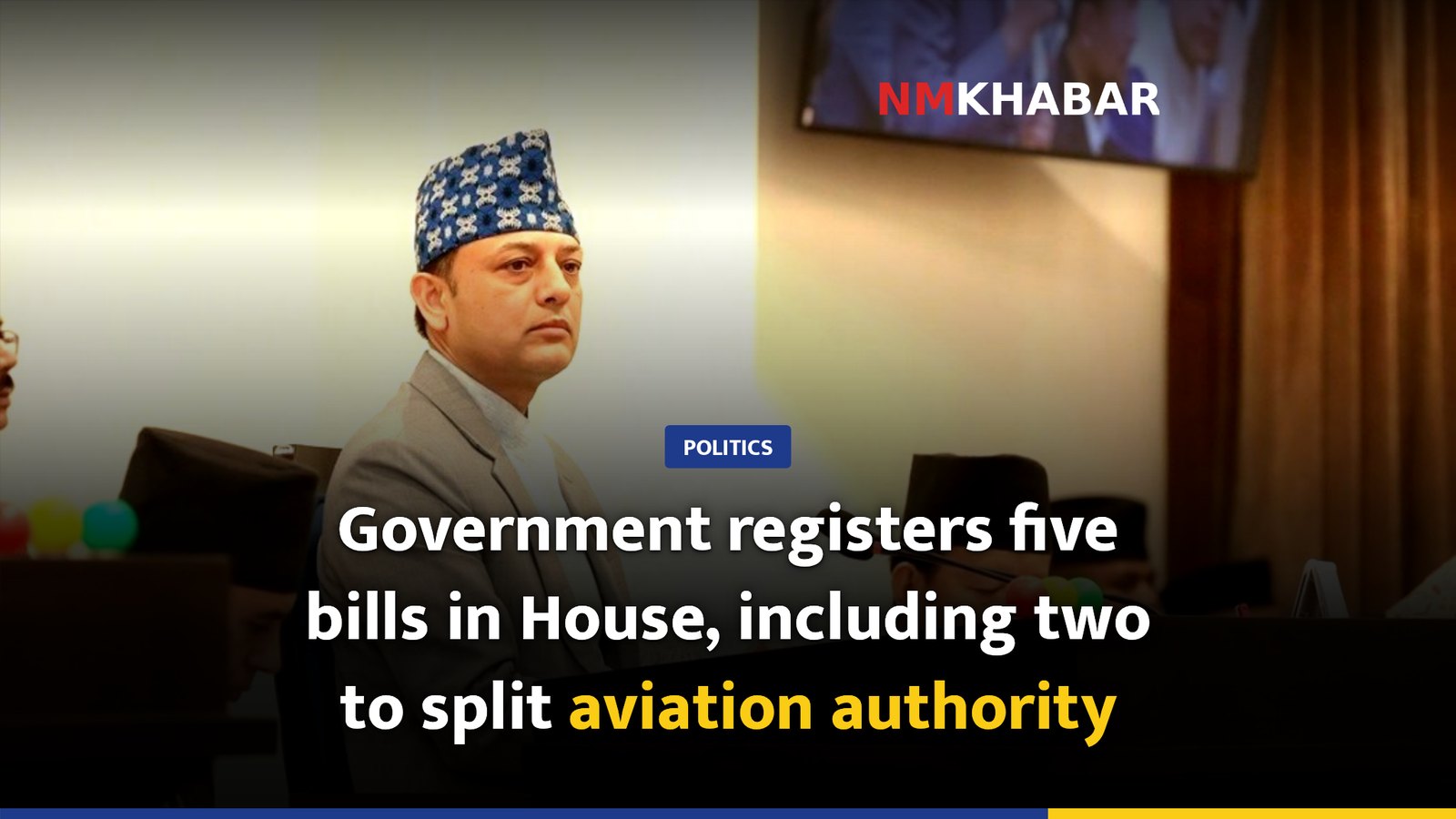
The Nepali government registered five bills in the House of Representatives, the lower house of parliament, on Friday, October 2, 2026. Among them are two crucial pieces of legislation aimed at splitting the Civil Aviation Authority of Nepal (CAAN), the country’s aviation regulator and service provider, into separate entities.Culture, Tourism and Civil Aviation Minister Khadak Raj Paudel registered the ‘Nepal Air Service Authority Bill, 2083’ and the ‘Nepal Civil Aviation Authority Bill, 2083’ in the House. If passed, these bills will pave the way for the division of CAAN, a fully state-owned autonomous body established on December 31, 1998, which has been performing both regulatory and service-providing roles.Minister Paudel stated that separating these roles would eliminate existing conflicts of interest in the sensitive aviation sector, which is closely linked to air passenger safety. He added that air navigation services and airport operations could be managed more effectively in line with international practices. “The regulatory function will become more autonomous and robust, bringing air navigation services, airport operation services, and aviation training institutions under its regulatory scope, thereby making air services safer,” Minister Paudel said.The minister expressed confidence that the move would help address flight safety concerns raised by the International Civil Aviation Organization (ICAO), the global aviation body, and the European Union (EU), the economic and political union of 27 member states, regarding Nepal’s civil aviation.He also believes that the specialized operation of current civil aviation activities will improve service quality, efficiency, and professionalism among employees, leading to better flight and airport operation standards. This restructuring is expected to be positively evaluated by other countries and relevant organizations as Nepal’s airports and air navigation structures align with international standards.Alongside the aviation bills, the government also registered three other bills on Friday. These include the ‘Good Governance (Management and Operation) (First Amendment) Bill, 2083’ from the Prime Minister and Council of Ministers Office, the executive body of the Nepal government, and the ‘Building (Second Amendment) Bill, 2083’ and the ‘National Road Safety Bill, 2083’ from the Ministry of Infrastructure Development, the government ministry responsible for infrastructure development.
Addressing International Concerns
The debate over splitting CAAN into regulatory and service-providing bodies has been ongoing for over a decade and a half. The International Civil Aviation Organization (ICAO)’s Universal Safety Oversight Audit Programme first highlighted CAAN’s dual role in May 2009. Subsequent audits in 2013, 2017, and 2022 reiterated this concern, recommending that the service-providing and regulatory functions be clearly separated as a high priority.Nepal has consistently informed international civil aviation forums, such as ICAO conferences, about its institutional reforms to operate regulatory and service-providing functions through separate entities. While Nepal’s aviation sector has been removed from ICAO’s Significant Safety Concerns list, it remains on the European Union’s blacklist. Officials believe these new bills will help address the EU’s concerns.
What Happens Next
The registered bills will now proceed to parliamentary committees for detailed discussion. After committee review, they will be presented back to the House of Representatives for further debate and eventual passage. If passed and authenticated by the President, the Nepal Civil Aviation Authority Act, 2053 will be repealed. The ‘Nepal Air Service Authority Bill, 2083’ is slated to come into effect 91 days after presidential authentication.The new Nepal Air Service Authority will be responsible for airport infrastructure development, commercial services, air navigation, technical services, flight safety, risk management, and coordination with regulatory bodies. The restructured Nepal Civil Aviation Authority will handle certificate and license management, aircraft registration, individual licenses, standard setting and regulation, safety supervision, international obligations, and policy coordination.The ultimate goal of CAAN’s restructuring is to establish an independent regulator, an autonomous service provider, and leadership accountable for results. However, discussions continue regarding the necessity of ensuring the independence of the regulator, the autonomy of the service provider, and competent leadership for the institutional division to be complete.