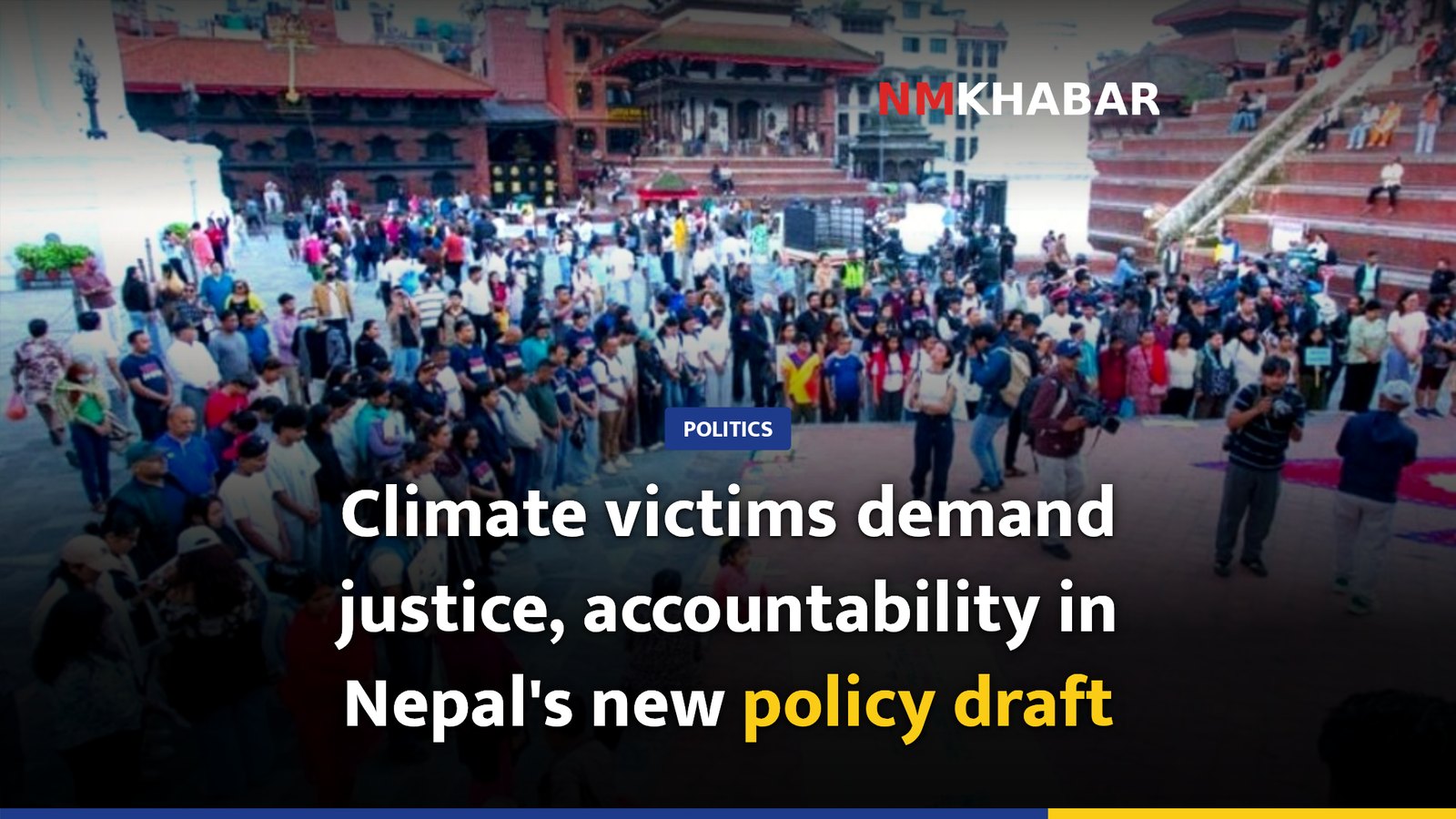
Climate victims and activists in Kathmandu demanded that Nepal’s new climate policy prioritize “climate justice,” easy access to climate finance, and accountability from polluting nations. The call came during a programme held on Saturday in Kathmandu, where participants highlighted that Nepal, despite its negligible contribution to global carbon emissions, bears a disproportionately high cost of climate-induced disasters.
Nepal is ranked fourth globally for its vulnerability to climate change, with over 80 percent of its population directly affected. Germanwatch’s Climate Risk Index 2020 also placed Nepal ninth among nations most impacted by climate disasters between 1999 and 2018.
Pratima Ghala from Dhading, a climate victim, highlighted the injustice. “Our contribution to carbon emissions is less than one percent, yet why are we paying such a heavy price for its devastating floods? We demand an answer,” she stated. Sonia Syangbo from Rasuwa, who lost her home and relatives in a disaster, emphasized that victims need justice, not just sympathy. She urged the government to implement special social security programmes for the elderly and unprotected children. Angel Bishwakarma, affected by the Bhote Koshi floods, shared her pain through a poem, describing how sudden floods swept away homes, loved ones, and dreams.
Climate activist Sujita Mathema stressed that justice for those affected by climate disasters, swift and easy access to climate finance, and holding polluter nations accountable must be central to the new policy. She pointed out the slow process of receiving aid from climate funds, even as Nepal faces high risks from glacial lake outbursts. Mathema advocated for the “polluter pays” principle, where countries responsible for pollution should bear the cost of damages. “Our main demands are justice for climate disaster victims, a system for climate finance to reach Nepal easily and quickly, and making polluters accountable,” Mathema said.
Fellow activist Bishnu Khanal echoed these sentiments, stating that the suffering of climate-affected people should not be reduced to mere statistics. He argued that finance provided for loss and damage should be seen as an obligation of developed and polluting nations, not charity. “We need justice, not sympathy,” Khanal asserted. “Where did the smoke originate, who benefited, and who is paying the price? We are not seeking revenge, but accountability.”
Nepal’s Climate Policy Framework
Nepal has proposed a draft of the National Climate Policy, 2083, which includes 15 thematic areas, 55 strategies, and approximately 288 action plans. The draft was released on Assoj 6 (September 22, 2026), with a 10-day period for public suggestions. The Ministry of Agriculture, Forests and Environment, which is responsible for climate change policy and management in Nepal, will receive these suggestions.
The country is estimated to require USD 47.4 billion for adaptation programmes by 2050, with USD 1.5 billion from internal sources and USD 45.9 billion from external sources. The reconstruction of energy infrastructure damaged by the Bhote Koshi-Trishuli floods alone is now estimated to cost approximately Rs 390 billion, a significant increase from the initial estimate of Rs 124 billion due to structural changes, price increases, and rising river levels.
International Engagement and Future Steps
Nepal has actively engaged in climate change management since becoming a party to the United Nations Framework Convention on Climate Change (UNFCCC) in 1994. It developed a National Adaptation Programme of Action (NAPA) in 2010 and implemented the National Climate Change Policy, 2076 (2019).
In a recent development, Nepal signed its first bilateral agreement on international carbon trade with Sweden during the COP-29 conference in Baku, Azerbaijan.
Speaker of the House of Representatives Dolprasad Aryal is scheduled to present a special proposal on Nepal’s federal parliament and the impacts of climate change at the 153rd General Assembly of the Inter-Parliamentary Union (IPU) in Tanzania on Assoj 18 (October 4, 2026).
The final date for the implementation of the new National Climate Policy, 2083, remains unknown. Similarly, the current status of the government’s climate finance management strategy, which has been prepared but not yet passed, is also unclear.