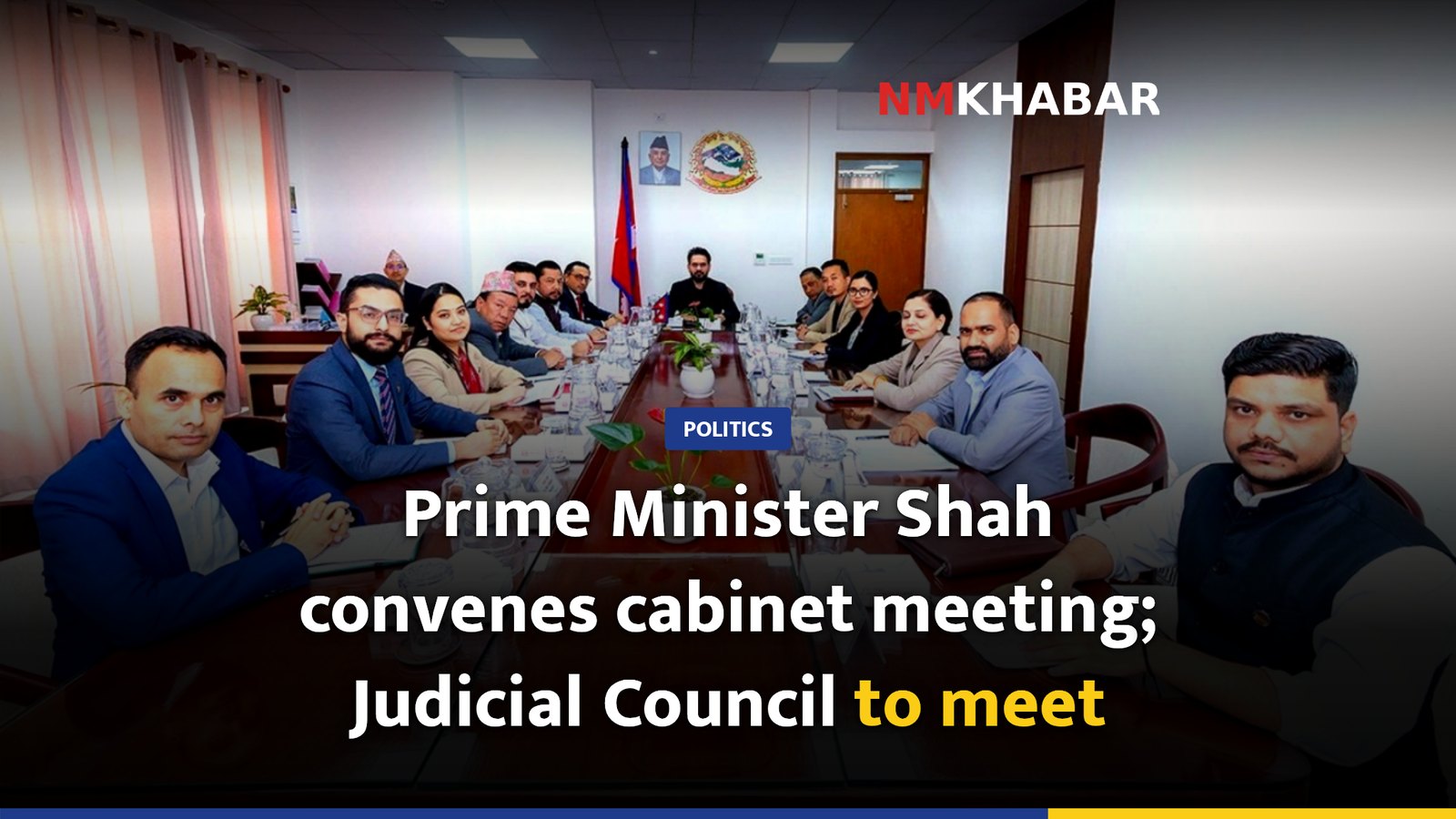
Prime Minister Balendra Shah has convened a cabinet meeting today, Monday, October 5, 2026, at 3 PM at the Prime Minister’s Office in Singha Durbar, Kathmandu. Separately, the Judicial Council, a body responsible for recommending judicial appointments, will meet tomorrow to discuss recommendations for four vacant Supreme Court judge positions.
Cabinet and Judicial Council Meetings
The Prime Minister’s Secretariat announced that today’s cabinet meeting is expected to address regular administrative functions and various policy and contemporary issues. However, a detailed agenda has not been publicly disclosed.
Chief Justice Manojkumar Sharma has called the Judicial Council meeting for Tuesday, October 6, 2026, at 1 PM. The council, chaired by Chief Justice Sharma, includes Law Minister Sobita Gautam and senior Supreme Court Justices Sapana Pradhan Malla, Maheshkumar Nepal, and Damodar Khadka. The primary purpose of the meeting is to deliberate on and recommend candidates to fill the four vacant Supreme Court judge positions.
Meanwhile, Speaker Dolprasad Aryal departed for Tanzania on October 4, 2026, to participate in the 153rd Assembly of the Inter-Parliamentary Union (IPU), a global organization of national parliaments. The assembly is scheduled to run from October 5 to 9, 2026.
Prime Minister Shah’s Political Journey
Balendra Shah, a structural engineer and rapper, became Nepal’s 43rd Prime Minister on March 27, 2026. His appointment followed the Rastriya Swatantra Party (RSP) securing a nearly two-thirds majority in the House of Representatives election on March 5, 2026. Shah notably defeated former Prime Minister KP Sharma Oli in the Jhapa-5 constituency by a margin of approximately 50,000 votes.
His government was formed under Article 76(1) of Nepal’s Constitution 2072, marking the first time a Prime Minister has been appointed using this specific provision since the constitution’s promulgation. Before assuming the premiership, Shah served as the 15th Mayor of Kathmandu Metropolitan City from 2079 to 2082 BS. A significant political shift, known as the “Gen Z Movement,” in September 2025, contributed to the collapse of the previous government, paving the way for the RSP’s rise.
Growing Discontent in Madhesh
Prime Minister Shah is the first Prime Minister of Madhesi origin. Initially, the RSP garnered unprecedented support in Madhesh during the March 5 election, securing historic votes in both direct and proportional representation categories. However, within 100 days of the government’s formation, discontent has reportedly grown in the Madhesh province, with even some RSP lawmakers expressing dissatisfaction.
Leaders of Madhesh-centric parties, including Upendra Yadav, Mahant Thakur, Prabhu Shah, Rajendra Mahato, and CK Raut, are reportedly suspicious of Prime Minister Shah. CK Raut has warned that the country could face a crisis and the balance of state organs could be disrupted if the current situation persists. Demands from Madhesh include fair market prices for crops and government support for fertilizers, seeds, and technical assistance. Some reports indicate that Madhesh-centric parties are preparing to intensify protests against the Balendra Shah government after the Chhath festival.
Rabi Lamichhane, Chairman of the Rastriya Swatantra Party, has asserted that the Balendra Shah-led government would not collapse and urged respect for the public mandate.
Uncertainties Remain
The specific agenda and decisions expected from today’s cabinet meeting have not been made public. Similarly, the names of the candidates who will be recommended to fill the four vacant Supreme Court judge positions remain unknown. The long-term impact of the growing discontent in Madhesh on the stability of the Balendra Shah government is also yet to be seen.