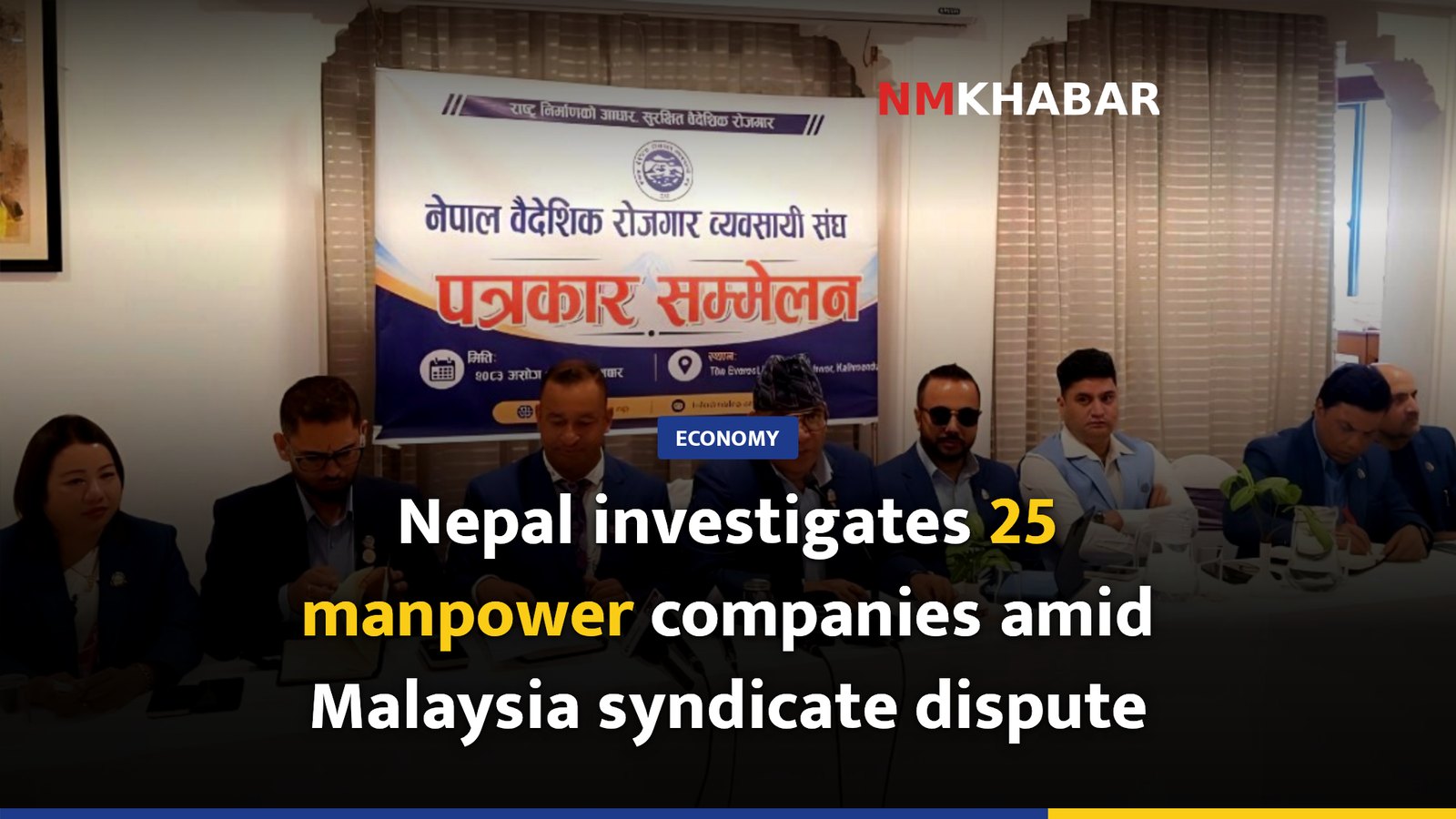
Nepal’s government has initiated an investigation into 25 main manpower companies and requested the Malaysian government to remove them from a controversial online recruitment system. This action comes amid concerns that a syndicate could be imposed on Nepali workers seeking employment in Malaysia, which the Nepal Association of Foreign Employment Agencies (NAFEA) warns could affect the livelihoods of approximately 1,200 licensed foreign employment agencies in Nepal.
The Nepal Association of Foreign Employment Agencies (NAFEA), the umbrella organisation of foreign employment entrepreneurs, has strongly objected to Malaysia’s ‘Foreign Worker Centralised Management System’ (FWCMS). This system has listed 25 Nepali manpower companies as main and 250 as auxiliary institutions without transparent criteria, according to NAFEA. The association deems the mechanism, which allows only these selected companies to send Nepali workers, as discriminatory.
Government takes firm stance against syndicate
In response to the growing dispute, the Ministry of Youth, Labour and Employment has instructed the Department of Foreign Employment (DoFE), Nepal’s regulatory body for foreign employment, to investigate the business transactions of the 25 main manpower companies since their establishment. DoFE has also been directed to seek clarification from the 250 auxiliary companies. Furthermore, DoFE has ordered manpower companies affiliated as ‘Principal Recruiting Agencies’ within the FWCMS to withdraw their affiliation.
Despite Nepal’s efforts, the Malaysian government has maintained its stance to only permit its chosen 275 manpower companies to recruit workers from Nepal. Prime Minister Balen Shah has directly engaged with his Malaysian counterpart, Anwar Ibrahim, via telephone, urging for equal opportunities for all legitimate Nepali manpower companies.
Impact on workers and industry
NAFEA President Dik Bahadur (Kumar) Khatri stated on Monday that the issue of opening employment opportunities in Malaysia should not be conflated with the imposition of a syndicate. He emphasised that opening employment and granting exclusive rights to a limited number of institutions are entirely separate matters. Khatri asserted that no foreign private system should arbitrarily disqualify companies that have received legitimate licenses from the Nepal government.
The association warns that such a syndicate would directly impact the businesses of other licensed agencies and ultimately impose an additional financial burden on vulnerable Nepali workers. With approximately 400,000 Nepali workers currently in Malaysia, NAFEA warns that a syndicate could lead to exorbitant costs, reducing their net income and making foreign employment more challenging for low-income families. The current minimum monthly wage in Malaysia is 1,700 Ringgit (approximately Rs 63,000), with discussions underway to increase it to 2,000 Ringgit.
Historical context and future risks
This is not the first time attempts have been made to control the process of sending Nepali workers to Malaysia through limited entities. NAFEA cited past instances involving biometric medicals, visa processing, and other systems that led to increased influence by specific groups. Eight years ago, a similar dispute over additional fees imposed on workers for biometric and visa processing led to a 15-month halt in Malaysian employment.
A zero-cost labour agreement between Nepal and Malaysia was signed in 2018. However, the labour agreement, which expired in 2023, is yet to be renewed, a matter NAFEA has urged the government to expedite. Malaysia had halted worker intake from all source countries, including Nepal, from May 31, 2024 (Jestha 18, 2081 BS), stating its intention to streamline recruitment via FWCMS and curb illegal fees and brokers.
NAFEA cautions that accepting a syndicate in Malaysia could set a dangerous precedent for other labour destination countries. The association demands a transparent investigation into the FWCMS system, including its legal basis, ownership, financial transactions, fee structure, and beneficiaries. The ongoing dispute has already affected the verification of new demand letters and the worker recruitment process. For more details on the potential impact, see our earlier coverage: Malaysia employment dispute: Department’s pressure raises syndicate fears, what about 400,000 workers’ future?
What remains unknown
The results of the detailed investigation into the selection criteria, evaluation basis, and potential illegal financial transactions related to the 25 main and 250 auxiliary manpower companies listed in the FWCMS are still pending. It remains unclear what Nepal’s diplomatic strategy will be given Malaysia’s continued insistence on using its preferred 275 companies. The final decision on raising the minimum monthly wage in Malaysia to 2,000 Ringgit is also awaited, as is the outcome of any investigation into potential pressure from state mechanisms or political leadership regarding the syndicate.