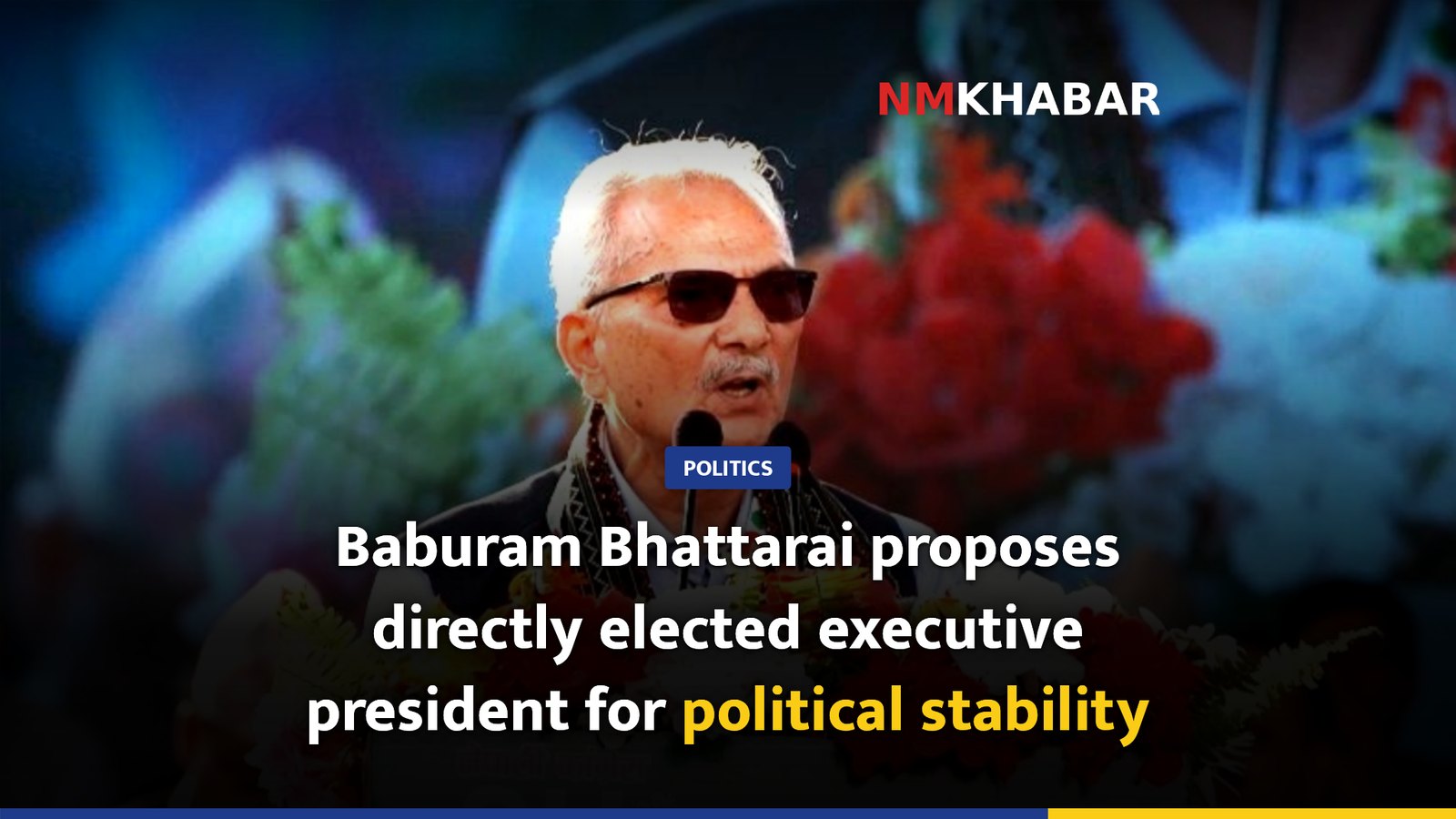
Former Prime Minister Baburam Bhattarai has proposed a directly elected executive president and a fully proportional electoral system as an alternative to ensure political stability in Nepal.
Speaking at the inaugural session of the Nepali Congress’ 15th General Convention at Khulamanch in Kathmandu, Bagmati province, on Sunday, October 4, 2026, Bhattarai emphasised that political stability is crucial for faster economic development. He noted that Nepal’s governments have historically remained in office for only around three years, with an average tenure of one to two years over the past 30-35 years, which creates significant challenges for long-term development.
Bhattarai also urged the current Rastriya Swatantra Party (RSP) government, led by Prime Minister Balen Shah, to complete its full five-year term. “Please sustain the current government. I wish you well and hope it lasts,” he said, adding, “But given our political tendencies, I cannot say what will happen.”
Addressing Systemic Instability
Bhattarai argued that a consensus on a different system of government is necessary. He called for political parties to agree on moving towards a directly elected executive president and a fully proportional legislature, with corresponding reforms to the federal structure. Bhattarai argued that such changes to the political and electoral system could provide a robust framework for achieving greater political stability and supporting sustained economic development.
Nepal has a long history of political instability, primarily due to frequent government changes. Factors contributing to this instability include corruption, legal interference, nepotism, leaders’ persistence in maintaining power, and geopolitical influences. The debate over a directly elected executive (president or prime minister) and a fully proportional electoral system has been ongoing since the first and second Constituent Assemblies.
Following the 2062/63 People’s Movement, Nepal adopted a mixed electoral system comprising 60% directly elected and 40% proportional representation. This system was intended to manage political conflict and address the country’s religious, cultural, and social diversity. However, it has faced criticism for being expensive, exhibiting shortcomings, and failing to ensure full proportional representation.
The Path Forward
The Nepali Congress’ 15th General Convention, which began on Sunday, October 4, 2026, and will conclude on October 8, 2026, will elect a new 232-member Central Working Committee and discuss policies and programmes to connect the party with the public. The ongoing discussions at the convention, including group discussions in halls named ‘Himal, Pahad, and Tarai-Madhesh,’ indicate the representation of the Madhesh region in political discourse.
The debate on electoral and governance system reforms, including a directly elected executive and a fully proportional system, is expected to continue. While the Election Commission has studied electoral system reforms, it has stated that issues requiring constitutional amendments are matters for political consensus.
Unanswered Questions
It remains unclear how other major political parties, such as the Nepali Congress, CPN-UML, and CPN (Maoist Centre), will formally react to Bhattarai’s proposal. Additionally, a detailed framework or process for the constitutional amendments required to implement a directly elected executive president and a fully proportional legislature, as envisioned by Bhattarai, is not yet available. The current Rastriya Swatantra Party (RSP) government has also not formally responded to Bhattarai’s call for it to complete its five-year term.